
Moncton vs. Fredericton: Real Estate & Lifestyle Compared (2026)
A side-by-side guide to Moncton vs Fredericton for buyers and movers in 2026.
If you’re moving to New Brunswick, the first question is usually: Moncton or Fredericton? Both cities are affordable by Canadian standards, both offer a strong quality of life, and both are growing. But they’re different cities with different economies, different housing markets, and different day-to-day experiences.
Here’s a direct comparison based on 2026 data — no generalities, just honest numbers and what I’ve observed from helping clients who’ve weighed both options.
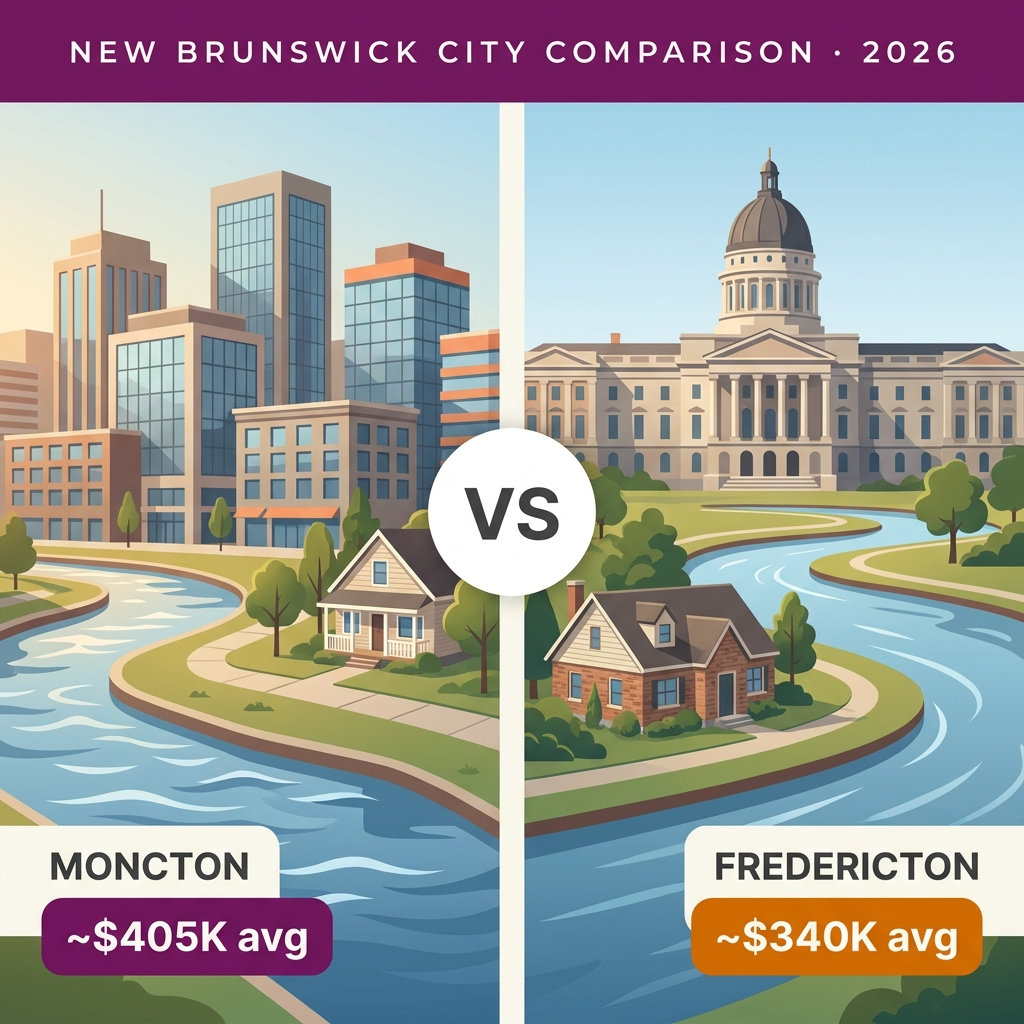
Key takeaways: Moncton vs Fredericton
- Moncton vs Fredericton comes down to housing costs, the job market, and the pace of daily life you want.
- This guide compares Moncton vs Fredericton on real estate, economy and employment, lifestyle, and schools, using 2026 data.
- Use the FAQ at the end for quick answers on Moncton vs Fredericton affordability, jobs, size and bilingualism.
Official city information: City of Moncton and Fredericton.
As a Moncton realtor with 16+ years of local experience, I track numbers like these every month so my clients don’t have to guess.
Moncton vs Fredericton at a glance
| Metric | Moncton | Fredericton |
|---|---|---|
| Metro population (2026 est.) | ~170,000 | ~125,000 |
| City proper population | ~85,000 | ~79,000 |
| Average home price (2025–2026) | ~$405,000 | ~$373,000 |
| Price change (YoY) | +9.1% | +8.6% |
| RE/MAX 2026 price forecast | +2.7% | +2% |
| Economy type | Diversified private sector | Government + university |
| Bilingual? | Yes — officially bilingual metro | Predominantly English |
| University | Université de Moncton | UNB, St. Thomas University |
| Drive to Halifax | ~2.5 hours | ~4.5 hours |
| Drive between cities | ~2 hours (180 km via Trans-Canada) | |
| Airport | YQM (more routes) | YFC |
Sources: Statistics Canada, CREA, RE/MAX Canada Housing Market Outlook 2026, WOWA, Wikipedia (Fredericton population).
Moncton vs Fredericton: real estate comparison
Price and what you get
Fredericton’s average home price sits about $30,000 below Moncton’s — roughly $373,000 vs $405,000 — making it slightly more accessible for entry-level buyers. The price difference reflects a few structural factors: Moncton has stronger interprovincial migration demand (particularly from Ontario), more new construction activity (especially in Dieppe), and a larger commercial economy that supports broader housing demand.
At comparable budget levels:
- $300,000–$350,000: In Fredericton, this buys a solid 3-bedroom detached home in an established neighbourhood like Skyline Acres or Nashwaaksis. In Moncton, you’re looking at the North End (Mapleton/Bridgedale) or older homes in Sunny Brae for the same budget.
- $400,000–$450,000: In Fredericton, this gets you a premium neighbourhood location or a newer build. In Moncton, this is the sweet spot for a good home in Lewisville, Riverview, or central Dieppe.
- $500,000+: Both cities have options at this level, but Moncton has more inventory — Royal Oaks, newer Dieppe developments, and Riverview’s best streets. Fredericton’s luxury market is smaller and less active.
Market conditions
Both cities are forecast to see modest price increases in 2026 (Moncton +2.7%, Fredericton +2%). However, the market dynamics differ:
- Moncton is moving toward a balanced market with strong migration-driven demand. Spring is competitive, with well-priced homes in desirable neighbourhoods receiving multiple offers.
- Fredericton is transitioning toward a buyer’s market as new construction increases. RE/MAX projects sales will decrease by 7% in 2026. Buyers may find more negotiating room here, particularly in the fall and winter.
Closing costs
Closing costs are identical in both cities — New Brunswick’s 1% Real Property Transfer Tax, legal fees ($1,500–$2,000), home inspection ($500–$700), and title insurance ($200–$400) apply across the province. There’s no difference in transaction costs between the two cities.
Economy and employment
This is where the two cities diverge most meaningfully.
Fredericton: Government and academia
Fredericton is New Brunswick’s capital, and the provincial government is the city’s largest employer by a wide margin. The University of New Brunswick (UNB) and St. Thomas University add a significant academic and research component. In recent years, Fredericton has also developed a growing technology sector, with companies in cybersecurity, IT services, and software development establishing offices downtown.
Fredericton has the highest per capita income and the highest post-secondary education rate in the province. Government jobs tend to offer strong stability, pensions, and benefits — making Fredericton attractive for public-sector professionals and their families.
Moncton: Diversified private sector
Moncton’s economy is more diversified and more commercially driven. Major employment sectors include logistics and transportation (the city sits at the crossroads of Atlantic Canada’s highway and rail networks), healthcare (The Moncton Hospital and surrounding medical facilities), contact centres, retail (Champlain Place is Atlantic Canada’s largest shopping centre), and bilingual professional services.
Moncton’s bilingual workforce is a genuine economic asset — many national companies choose Moncton for Atlantic operations specifically because of the availability of bilingual employees. This creates job opportunities that don’t exist in Fredericton’s predominantly English-speaking labour market.
For remote workers
If you work remotely, both cities are equally viable. Internet connectivity, coworking options, and quality of life are comparable. The deciding factors become lifestyle preferences, housing budget, and proximity to airports or other cities rather than employment.
Lifestyle comparison
Where Moncton wins
- More retail, dining, and entertainment options — as the larger metro, Moncton has more restaurants, more shopping, and venues like the Avenir Centre (concerts, events, hockey).
- Bilingual community and culture — access to both English and French communities, schools, cultural events, and the vibrant Acadian culture centred in Dieppe.
- Central Maritime location — Moncton is 2.5 hours to Halifax, 2 hours to Fredericton, 2 hours to Charlottetown, and 2 hours to the U.S. border. It’s the geographic hub of the Maritimes.
- Coastal proximity — Shediac and Parlee Beach are 25 minutes from Moncton. Hopewell Rocks (Bay of Fundy) is about an hour. Fredericton is landlocked.
- Airport — Greater Moncton’s YQM has more direct routes than Fredericton’s YFC, making travel easier.
Where Fredericton wins
- River city charm — the Saint John River runs through the centre of Fredericton, and the riverfront trail system is arguably more scenic and better-developed than Moncton’s Petitcodiac River trails.
- Cultural institutions — the Beaverbrook Art Gallery, the Harvest Jazz & Blues Festival, and a thriving arts community give Fredericton a cultural depth that punches above its size.
- University town feel — UNB and St. Thomas give Fredericton a campus-town atmosphere with lectures, events, and a young population that keeps the downtown vibrant.
- Government job stability — if your career is in the public sector, being in the capital means direct access to departments, agencies, and career mobility within the provincial civil service.
- Slightly lower home prices — the $30K average gap means your housing dollar stretches a bit further, especially at the entry level.
Schools
Both cities have strong English-language schools through the Anglophone school districts. The key difference is French-language education:
- Moncton has a robust French-language school system (District scolaire francophone Sud) with schools throughout Dieppe and Moncton, plus French immersion options within the English system. The Université de Moncton is the largest French-language university outside Quebec.
- Fredericton has French-language school options (District scolaire francophone Sud – Fredericton), but the francophone community is smaller and options are more limited. UNB and St. Thomas are English-language institutions.
If bilingual education is a priority for your children, Moncton’s infrastructure for French and French-immersion schooling is significantly deeper.
Moncton vs Fredericton: which city is right for you?
| Your situation | Better fit |
|---|---|
| Government or public sector career | Fredericton |
| Private sector, logistics, healthcare | Moncton |
| Bilingual family / French education priority | Moncton |
| Tightest possible budget (< $350K) | Fredericton |
| New construction / modern neighbourhoods | Moncton (Dieppe) |
| University town feel / arts & culture | Fredericton |
| Coastal access / beach proximity | Moncton |
| Central location for travel | Moncton |
| Remote work / lifestyle choice | Either — depends on personal preference |
| River city with scenic trails | Fredericton |
Curious how Moncton stacks up against other Maritime cities? See our comparisons with Saint John and Charlottetown.
A note on investing
From a pure real estate investment perspective, Moncton currently has stronger demand-side fundamentals: faster population growth, more interprovincial migration, a larger rental market, and more active new construction. Fredericton’s market is more stable but slower — and RE/MAX projects Fredericton will move toward a buyer’s market in 2026 while Moncton stays balanced.
That said, Fredericton offers opportunities for investors who are patient and strategic — particularly in the student rental market near UNB and in entry-level properties that may appreciate as the city grows.
Moncton vs Fredericton: frequently asked questions
Is Moncton or Fredericton more affordable for housing?
Fredericton has a lower average home price — approximately $373,000 compared to Moncton’s approximately $405,000 in early 2026. However, Moncton’s higher price reflects its faster population growth, stronger demand from interprovincial migration, and larger commercial economy. Both cities remain far more affordable than major Canadian metros. Fredericton offers more entry-level options in the $250K–$350K range, while Moncton has more new construction and a broader range of neighbourhoods at the $350K–$500K level.
Is Moncton or Fredericton better for jobs?
It depends on your sector. Fredericton’s economy is anchored by the provincial government, universities (UNB, St. Thomas), and a growing tech sector. It has the highest per capita income and highest post-secondary education rate in New Brunswick. Moncton has a more diversified private-sector economy — logistics, contact centres, healthcare, retail, and bilingual professional services. Moncton’s larger metro population (approximately 170,000 vs Fredericton’s 125,000) supports a wider range of employers and industries.
Which is bigger, Moncton or Fredericton?
Moncton is bigger. Greater Moncton (including Moncton, Dieppe, and Riverview) has a metro population of approximately 170,000 and added roughly 27,000 residents between 2021 and 2024. Fredericton’s metro population is approximately 125,000, with the city proper at about 79,000. Moncton is New Brunswick’s largest metro area, while Fredericton is the provincial capital and third-largest city.
Is Moncton or Fredericton more bilingual?
Moncton is significantly more bilingual. Greater Moncton — particularly Dieppe, where 71% of residents report French as their mother tongue — is the only officially bilingual metropolitan area in Canada. Fredericton is predominantly English-speaking, though it does have French-language schools and a small francophone community.
How far apart are Moncton and Fredericton?
Moncton and Fredericton are approximately 180 kilometres apart via the Trans-Canada Highway (Route 2). The drive takes roughly 2 hours under normal conditions. There is no passenger rail service between the two cities. Both cities have regional airports — Greater Moncton Roméo LeBlanc International Airport (YQM) and Fredericton International Airport (YFC).
Considering a move to Greater Moncton?
If you’ve narrowed your decision to Moncton, I’m happy to walk you through current listings, neighbourhood options, and what your budget buys in each part of the tri-city area. I’ve helped dozens of families navigate this exact decision — many coming from Ontario, some moving within New Brunswick from Fredericton or Saint John. Buying from out of province? See how to buy a home remotely in Moncton.
No obligation, no pressure. Just honest numbers and local insight from 16+ years in this market.