A 2026 guide to closing costs in New Brunswick for home buyers.
If you’re buying a home in New Brunswick, the down payment isn’t the only cash you need on closing day. Closing costs — the one-time fees, taxes, and adjustments that come due when title transfers — typically add 2% to 4% of the purchase price to your out-of-pocket total.
On a $400,000 home in Moncton, Dieppe, or Riverview, that’s an extra $8,000–$12,000 you need to have in the bank on top of your down payment. Most first-time buyers underestimate this number, and it’s the single most common source of last-minute scrambling in the two weeks before closing.
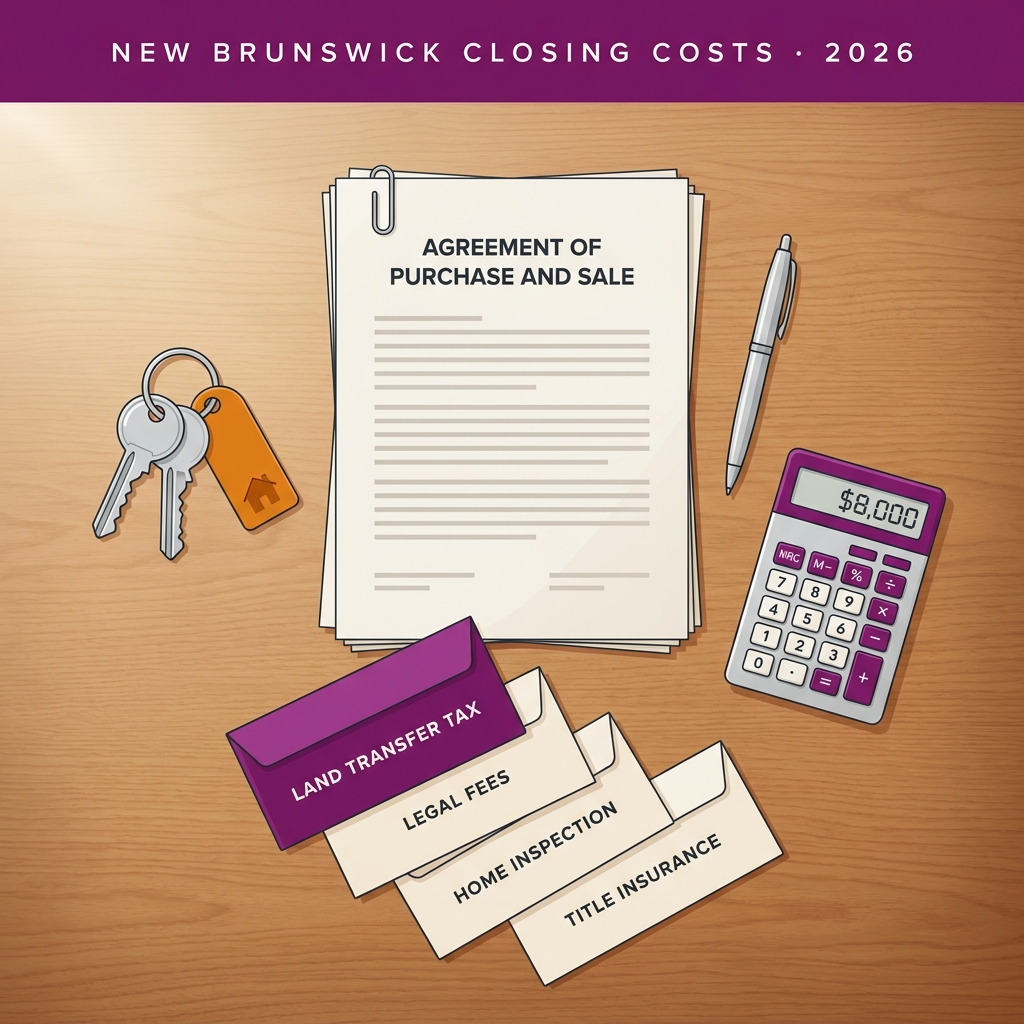
Key takeaways: closing costs in New Brunswick
- Closing costs in New Brunswick typically add 2% to 4% of the purchase price.
- The largest item is the 1% Real Property Transfer Tax, and New Brunswick has no first-time buyer rebate on it.
- On a $400,000 Moncton home, budget roughly $8,000 to $12,000 on top of your down payment.
Land transfer tax and property records: Service New Brunswick.
Here’s a complete, up-to-date breakdown of every closing cost you’ll encounter as a buyer in New Brunswick, with real dollar examples for three common price points.
Watch: New Brunswick Closing Costs Explained | What First-Time Home Buyers Forget
Quick summary: closing costs in New Brunswick
| Cost | Typical amount | When it’s due |
|---|---|---|
| Real Property Transfer Tax (land transfer tax) | 1% of price or assessed value (whichever is higher) | At closing, through your lawyer |
| Legal fees & disbursements | $1,500–$2,000 | At closing |
| Home inspection | $500–$700 | Before closing (conditional period) |
| Title insurance | $200–$400 | At closing |
| Property tax & utility adjustments | Varies (prorated) | At closing |
| CMHC mortgage insurance (if < 20% down) | 2.80%–4.00% of mortgage | Added to mortgage (not paid in cash) |
| HST on new construction (first-time) | Varies; partial rebate available | At closing |
1. Real Property Transfer Tax: the biggest closing cost in New Brunswick
This is almost always the largest closing cost outside your down payment. It’s a flat 1% tax levied under New Brunswick’s Real Property Transfer Tax Act, and it applies to every residential property purchase in the province — no exceptions for first-time buyers, no exceptions for private sales, no exceptions for family transfers outside of narrow cases (such as transfers between spouses or under a will).
How it’s calculated
The tax is 1% of the greater of:
- The purchase price you paid for the property, or
- The property’s assessed value as determined by Service New Brunswick.
For most market transactions, the purchase price and the assessed value are close, and the purchase price is used. But if you negotiate an exceptionally good deal and your purchase price ends up well below the SNB-assessed value, the tax is calculated on the higher assessed value. This catches buyers off guard occasionally, especially in private sales.
Who pays this closing cost in New Brunswick, and when
The buyer pays the Real Property Transfer Tax. Your lawyer handles the payment as part of registering the title transfer at Service New Brunswick on closing day — it appears on your closing statement and comes out of the funds you’ve advanced to your lawyer.
No first-time buyer rebate on New Brunswick closing costs
This is important to know up front: New Brunswick has no first-time buyer rebate for land transfer tax. Ontario, BC, and PEI all offer rebates ranging from $4,000–$4,475 for qualifying first-time buyers. New Brunswick does not. If you’re relocating from Ontario and expecting a rebate, adjust your budget accordingly.
What this actually costs
- $300,000 home → $3,000 transfer tax
- $400,000 home → $4,000 transfer tax
- $500,000 home → $5,000 transfer tax
- $600,000 home → $6,000 transfer tax
Source: Real Property Transfer Tax Act (NB); Government of New Brunswick, Department of Finance and Treasury Board.
2. Legal fees and disbursements
You need a New Brunswick lawyer to close a residential real estate purchase. The lawyer reviews the Agreement of Purchase and Sale, conducts a title search, registers the deed, handles the mortgage registration, arranges title insurance, and disburses funds on closing day.
Typical costs in Moncton, Dieppe, and Riverview
- Lawyer’s professional fee: $900–$1,400
- Disbursements (title searches, registration fees, courier, couriering documents to lender): $400–$600
- HST on legal fees: 15%
- Total typical range: $1,500–$2,000
Legal fees run slightly higher for:
- Newly built homes — additional new-build disclosures, warranty registrations (Atlantic Home Warranty or similar), and HST calculations.
- Rural or waterfront properties — additional title work for boundary descriptions, access easements, and septic/well documentation.
- Properties with known title issues — if earlier deeds have irregularities, the lawyer may do additional title work.
It’s worth getting a flat-fee quote in writing before you engage your lawyer. Most experienced Moncton-area real estate lawyers will provide one in 24 hours.
3. Home inspection
Home inspections aren’t legally required in New Brunswick, but they are standard practice on resale homes and strongly recommended. A qualified inspector will check the roof, foundation, structure, plumbing, electrical, HVAC, insulation, windows, and visible components of the property, and provide a written report — usually within 24–48 hours of the inspection.
- Typical cost in Greater Moncton: $500–$700 for a standard single-family home.
- Larger or older homes: $700–$900.
- Additional add-ons: Radon testing ($150–$250), thermal imaging ($100–$200), water quality testing for rural properties ($150–$250).
The inspection is paid directly to the inspector, typically within 7–10 days of your accepted offer, and is a non-refundable cost even if you later walk away from the property during the conditional period. For most buyers, spending $600 to potentially avoid a $30,000 surprise is money well spent.
I always recommend buyers add radon testing in Greater Moncton — our region has documented radon exposure zones and it’s one of the few hidden health risks that’s both inexpensive to check and inexpensive to mitigate if found.
4. Title insurance
Title insurance is a one-time premium that protects you against title defects, fraud, survey issues, and encroachments that may not be caught during the lawyer’s title search. It’s optional in theory, but virtually every mortgage lender in Canada requires it, and most New Brunswick lawyers include it as standard.
- Typical cost: $200–$400 for residential title insurance, one-time premium.
- Common providers: FCT (First Canadian Title), Stewart Title, Chicago Title.
Title insurance is a rare case where a small upfront cost provides disproportionate protection — and because the premium is one-time (not annual), it’s almost always worth it.
5. Property tax and utility adjustments
At closing, any property tax and utility bills the seller has already paid for the period after your closing date get credited back to them — and you reimburse them on the closing statement. Conversely, if the seller has arrears or unpaid property tax, those typically come off the purchase price. Buying from outside New Brunswick? Property tax works differently for you: see our guide to non-resident property tax in NB.
How this usually plays out
- Property taxes in New Brunswick are paid annually by the end of May. If you close in August, the seller has already paid the full year’s taxes — you reimburse them for September through December (roughly 4 months of property tax).
- Oil, propane, and fuel tanks — if the seller has a full tank at closing, you reimburse them for the current market value of the fuel. Sellers may include a “fuel adjustment” on the closing statement.
- Condo or HOA fees — reimbursement for any period already paid beyond closing.
On a typical Moncton-area closing, these adjustments are usually between $500 and $2,500, depending on time of year and whether the home uses oil heat.
6. CMHC mortgage default insurance (if your down payment is under 20%)
If you’re putting down less than 20%, federal rules require you to carry mortgage default insurance, almost always through CMHC (or one of the private insurers, Sagen or Canada Guaranty — rates are identical across all three).
Current CMHC premium rates (2026)
| Down payment | Premium rate |
|---|---|
| 5% to 9.99% | 4.00% of mortgage amount |
| 10% to 14.99% | 3.10% of mortgage amount |
| 15% to 19.99% | 2.80% of mortgage amount |
| 20% or more | No CMHC insurance required |
Source: CMHC, Canada Mortgage and Housing Corporation premium schedule, 2026. Note: First-time buyers and newly-built home buyers who choose a 30-year amortization add 0.20% (20 basis points) to the above rates.
Why this isn’t a closing-day cash cost
Unlike the other closing costs, the CMHC premium is almost always added to your mortgage rather than paid out of pocket. You pay it off over your amortization period as part of your regular mortgage payments. On a $360,000 mortgage at 4.00%, the $14,400 premium is rolled in — your monthly payment is slightly higher, but you don’t need that cash at closing.
The quiet New Brunswick advantage on closing costs
Ontario, Quebec, and Saskatchewan charge provincial sales tax (PST or QST) on the CMHC premium itself, and that tax must be paid in cash at closing. On a $360,000 mortgage, that’s an additional $1,000–$1,300 at closing for buyers in those provinces.
New Brunswick does not charge PST on CMHC insurance. This is a small but real saving for NB buyers with less than 20% down — and something most buyers relocating from Ontario don’t know until their NB closing statement comes in cheaper than expected.
7. HST on newly-built homes (partial rebate available)
If you’re buying a newly-built home (not a resale), HST at 15% applies to the purchase price. In most cases the HST is already baked into the builder’s listed price, but you should always confirm whether the advertised price is HST-inclusive or HST-additional before signing.
The federal portion of the HST (5% GST) qualifies for a partial rebate — you can recover 36% of the GST portion, up to a maximum rebate of $6,300, for homes priced up to $450,000. The provincial portion (10% PST equivalent) is not rebatable in New Brunswick.
This is one of the more confusing closing-cost areas for new-build buyers. Your lawyer handles the calculation, but always ask the builder whether the advertised price includes HST and what rebates are being assigned to the sale.
Real closing costs in New Brunswick: Greater Moncton examples (2026)
Here’s what actual closing costs look like for three realistic buyer scenarios in Moncton, Dieppe, or Riverview:
Example 1: First-time buyer, $320,000 townhome, 5% down
| Real Property Transfer Tax (1%) | $3,200 |
| Legal fees (incl. HST) | $1,800 |
| Home inspection + radon test | $750 |
| Title insurance | $300 |
| Property tax adjustment | $700 |
| Total closing-day cash (not incl. down payment) | ~$6,750 |
| CMHC premium (added to mortgage, not cash) | $12,160 |
Example 2: Repeat buyer, $425,000 detached home, 20% down
| Real Property Transfer Tax (1%) | $4,250 |
| Legal fees (incl. HST) | $1,900 |
| Home inspection + radon test | $800 |
| Title insurance | $350 |
| Property tax & fuel adjustment | $1,400 |
| Total closing-day cash | ~$8,700 |
| CMHC premium | $0 (not required at 20% down) |
Example 3: Relocation buyer, $550,000 newer home in Dieppe, 20% down
| Real Property Transfer Tax (1%) | $5,500 |
| Legal fees (incl. HST, higher for newer home) | $2,100 |
| Home inspection + radon test + thermal | $950 |
| Title insurance | $400 |
| Property tax & utility adjustments | $1,800 |
| Total closing-day cash | ~$10,750 |
Across all three scenarios, closing costs land between 2% and 2.4% of the purchase price. Budget 3% to be safe, and you’ll almost always have a comfortable margin.
Beyond closing costs: moving, utilities, and insurance in New Brunswick
A few costs aren’t technically “closing costs” but hit in the same two-week window and should be in your cash plan:
- Home insurance: Must be in place on the closing date. Typical first-year premium: $800–$1,500 for a Moncton-area home.
- Utility setup: NB Power, Enbridge/Liberty (if gas), Bell/Rogers. Usually $0–$100 in setup fees.
- Movers: Local move in Greater Moncton: $500–$1,500. Interprovincial move from Ontario: $4,000–$8,000.
- Immediate furniture or appliance purchases: Budget whatever feels realistic; new-home buyers often spend $2,000–$5,000 in the first month.
FAQ: closing costs in New Brunswick
How much are closing costs in New Brunswick?
Closing costs in New Brunswick typically range from 2% to 4% of the purchase price, on top of the down payment. On a $400,000 home, expect roughly $8,000–$12,000 in total closing costs. This includes the 1% Real Property Transfer Tax (~$4,000), legal fees ($1,500–$2,000), home inspection ($500–$700), title insurance ($200–$400), and property tax and utility adjustments at closing.
What is the land transfer tax in New Brunswick?
New Brunswick’s land transfer tax, officially called the Real Property Transfer Tax, is a flat 1% of the greater of the property’s purchase price or its assessed value as determined by Service New Brunswick. It is set under the Real Property Transfer Tax Act and has been at 1% since April 1, 2016. There is no tiered rate, no first-time buyer rebate, and no exemption for private sales. Your lawyer pays it on your behalf at registration as part of your closing statement.
Do first-time home buyers get a rebate on land transfer tax in NB?
No. Unlike Ontario, British Columbia, and Prince Edward Island, New Brunswick does not offer a land transfer tax rebate or exemption for first-time home buyers. The 1% Real Property Transfer Tax applies to every residential purchase regardless of whether you are a first-time buyer, repeat buyer, or investor. First-time buyers in NB should budget for the full amount as part of their closing cost plan.
How much are legal fees when buying a home in Moncton?
Legal fees for a standard residential purchase in Moncton typically range from $1,500 to $2,000, including the lawyer’s professional fee, disbursements (title search, registration fees, courier costs), and HST. Fees are slightly higher for rural or waterfront properties due to additional title work, and for newly-built homes due to new-build disclosures and warranty registrations. Most Moncton buyers should plan for $1,800 as a realistic mid-range estimate.
Is there PST on CMHC insurance in New Brunswick?
No. New Brunswick does not charge provincial sales tax on CMHC or other mortgage default insurance premiums. PST on mortgage default insurance only applies in Ontario (8%), Quebec (9%), and Saskatchewan (6%). This means NB buyers with less than 20% down save roughly $800–$1,500 at closing compared to buyers in those provinces. The CMHC premium itself is added to your mortgage and paid off over the amortization — it does not need to come out of your closing-day cash.
Budget for closing costs in New Brunswick with confidence
Every buyer I work with gets a personalized closing cost estimate before we write an offer, not after. That way we know exactly what your cash-to-close number looks like and there are no scrambles in the two weeks before closing day.
If you’re getting ready to buy in Greater Moncton and want a realistic closing-cost estimate for a specific price range or specific neighbourhood — I’m happy to walk through it with you. No obligation, no pressure, just honest numbers.