A complete 2026 guide to the first-time home buyer programs available in New Brunswick.
If you’re buying your first home in New Brunswick, there are several federal programs designed to help you save for a down payment, reduce your tax bill, and lower your monthly mortgage costs. Some of these programs are new — the FHSA only launched in 2023 — and many first-time buyers don’t realize how much they can stack together.
Here’s a complete guide to every program available to first-time home buyers in NB as of 2026, with real dollar examples based on what homes actually cost in Greater Moncton.
Key takeaways: first-time home buyer programs in NB
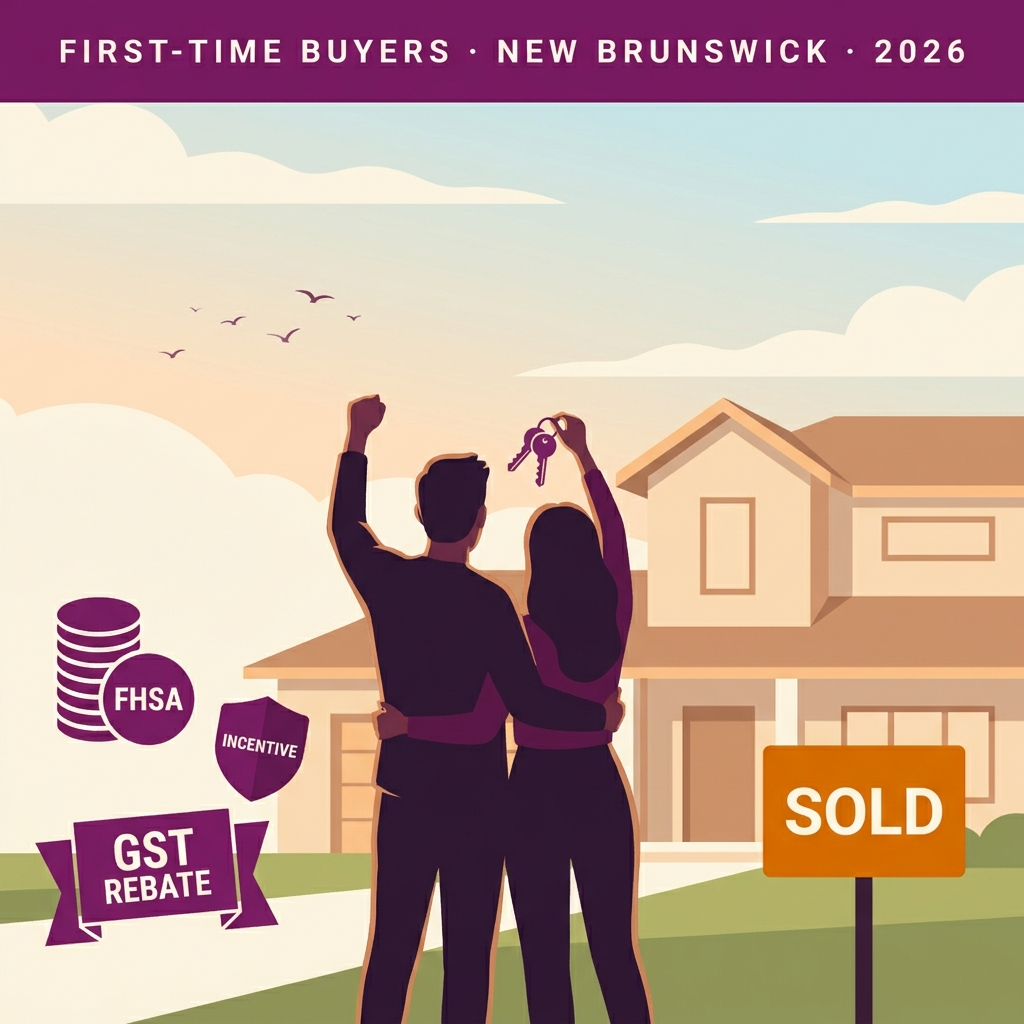
- The first-time home buyer programs available in New Brunswick in 2026 are federal: the FHSA, the RRSP Home Buyers’ Plan, 30-year amortization, the Home Buyers’ Tax Credit and the GST/HST New Housing Rebate.
- The FHSA and the Home Buyers’ Plan can be combined, which is where most first-time home buyer savings come from.
- New Brunswick has no provincial land transfer tax rebate for first-time buyers.
Mortgage insurance and down payment rules: Canada Mortgage and Housing Corporation (CMHC).
Watch: New Brunswick First-Time Home Buyer Programs Explained (FHSA, HBP, Tax Credits)
Quick reference: first-time home buyer programs at a glance
| Program | Benefit | Max amount | Repayment required? |
|---|---|---|---|
| First Home Savings Account (FHSA) | Tax-deductible contributions + tax-free withdrawals | $40,000 lifetime ($8,000/year) | No |
| RRSP Home Buyers’ Plan (HBP) | Tax-free RRSP withdrawal for down payment | $60,000 per person | Yes — over 15 years |
| 30-year amortization (insured) | Lower monthly payments | N/A | N/A (mortgage structure) |
| Home Buyers’ Tax Credit (HBTC) | Non-refundable tax credit | $10,000 credit (worth up to $1,500) | No |
| GST/HST New Housing Rebate | Partial rebate on new-build HST | Up to $6,300 (federal portion) | No |
Important note: New Brunswick does not have any provincial-level first-time buyer programs. All of the programs below are federal. NB also does not offer a land transfer tax rebate for first-time buyers — the 1% Real Property Transfer Tax applies to every purchase regardless.
1. First Home Savings Account (FHSA)
The FHSA is the most powerful savings vehicle available to first-time buyers in Canada, and it should be your first priority before contributing to an RRSP or TFSA for home-buying purposes.
How it works
The FHSA combines the best features of an RRSP and a TFSA into one account:
- Contributions are tax-deductible — like an RRSP, every dollar you contribute reduces your taxable income for the year.
- Growth is tax-free — like a TFSA, investment returns inside the account are never taxed.
- Qualifying withdrawals are tax-free — when you use the money to buy your first home, you pay zero tax on the withdrawal, including any investment gains.
This “triple tax advantage” — deduction going in, tax-free growth, tax-free withdrawal — doesn’t exist in any other Canadian savings account.
Key rules (2026)
- Annual contribution limit: $8,000 per year.
- Lifetime contribution limit: $40,000.
- Carryforward: Up to $8,000 of unused room carries forward per year. If you contributed $3,000 in 2025, you can contribute up to $13,000 in 2026 ($5,000 carried forward + $8,000 new room).
- Account lifespan: 15 years after opening, or the year you turn 71, whichever comes first.
- Contribution deadline: December 31 of each year. Unlike RRSPs, there is no 60-day grace period — contributions in January 2027 cannot be claimed on your 2026 tax return.
- No repayment required. Unlike the Home Buyers’ Plan, money withdrawn from the FHSA for a qualifying home purchase is permanently yours — there is no repayment schedule.
Who qualifies
- Canadian resident for tax purposes.
- At least 18 years old (age of majority in NB is 19, so NB residents must be 19 to open an FHSA).
- A first-time home buyer — meaning you have not lived in a home you (or your spouse) owned as your principal residence in the current year or any of the preceding four calendar years.
Real example: Moncton buyer
A 27-year-old renter in Moncton opens an FHSA in 2024 and contributes $8,000 per year. By 2029 — five years later — they’ve contributed $40,000 (the lifetime max). Assuming a modest 5% annual return, the account holds approximately $46,000. That’s enough for more than a 10% down payment on a $400,000 home — and the entire amount, including the $6,000 in growth, comes out completely tax-free. Plus, the $40,000 in contributions generated roughly $12,000–$16,000 in total tax deductions over those five years (depending on income and marginal rate).
The single best piece of first-time home buyer advice
Open the account now, even if you can only contribute $100. The 15-year clock and the carry-forward room both start the year you open the account. Waiting a year doesn’t save you money — it costs you a year of contribution room. Even a nominal initial deposit activates the account and starts accumulating carry-forward room for bigger contributions later.
Source: Canada Revenue Agency — First Home Savings Account (FHSA)
2. RRSP Home Buyers’ Plan (HBP)
The Home Buyers’ Plan lets you withdraw money from your RRSP to use as a down payment on your first home — without paying income tax on the withdrawal.
Key rules (2026)
- Maximum withdrawal: $60,000 per person (increased from $35,000 in 2024).
- Couples: If both partners qualify, combined withdrawals can total $120,000.
- 90-day rule: Funds must be in the RRSP for at least 90 days before withdrawal. If you plan to withdraw in June 2026, contribute by March at the latest.
- Repayment: You must repay the withdrawn amount to your RRSP over 15 years, starting in the second year after the withdrawal year. Minimum annual repayment is 1/15th of the total. Any shortfall in a given year is added to your taxable income.
- Timing: You must buy or build the home by October 1 of the year after withdrawal.
The FHSA vs. HBP decision
If you’re deciding where to put your next dollar, the FHSA is almost always the better first choice because withdrawals never need to be repaid. The HBP is best used as a top-up — after you’ve maxed your FHSA, use the HBP to access additional RRSP funds for a larger down payment.
Here’s the comparison:
| Feature | FHSA | HBP |
|---|---|---|
| Tax deduction on contributions | Yes | Yes (regular RRSP rules) |
| Tax-free growth | Yes | Yes (inside RRSP) |
| Tax-free withdrawal for home | Yes | Yes |
| Repayment required | No | Yes — 15 years |
| Maximum per person | $40,000 + growth | $60,000 |
| Penalty for not repaying | N/A | Unpaid amount becomes taxable income |
Source: Canada Revenue Agency — Home Buyers’ Plan (HBP)
3. Combining the FHSA and HBP: the first-time home buyer stacking strategy
The CRA explicitly confirms that you can use both the FHSA and the HBP for the same qualifying home purchase. This is where things get powerful, especially for couples.
Single buyer stacking example
- FHSA: $40,000 contributed + ~$6,000 growth = ~$46,000 (tax-free, no repayment)
- HBP: $60,000 withdrawn from RRSP = $60,000 (tax-free, repay over 15 years)
- Total accessible: ~$106,000
Couple stacking example
- Both partners max FHSA: ~$92,000 combined (tax-free, no repayment)
- Both use HBP: $120,000 combined (tax-free, repay over 15 years)
- Total accessible: ~$212,000
On a $400,000 Moncton home, even a single buyer using both programs can assemble a 20%+ down payment entirely from tax-advantaged sources — eliminating the need for CMHC mortgage insurance and significantly reducing their mortgage balance and monthly carrying costs.
4. 30-year amortization for first-time buyers
As of December 15, 2024, first-time home buyers and purchasers of newly-built homes can choose a 30-year amortization on insured (CMHC) mortgages. Previously, the maximum insured amortization was 25 years.
What this means in practice
A longer amortization means lower monthly payments, which improves affordability and can help you qualify for a larger mortgage. The trade-off is more total interest over the life of the loan.
Example on a $380,000 mortgage at 4.5%:
| Amortization | Monthly payment | Total interest paid |
|---|---|---|
| 25 years | ~$2,100 | ~$250,000 |
| 30 years | ~$1,925 | ~$313,000 |
The 30-year option saves approximately $175/month — meaningful for a first-time buyer’s cash flow — but adds approximately $63,000 in total interest. Most buyers I work with choose 30-year amortization for the breathing room, then make accelerated payments once their income grows. You can always increase payments or make lump sums later to shorten the effective amortization.
CMHC premium impact
Choosing the 30-year amortization adds 0.20% (20 basis points) to the standard CMHC insurance premium. On a $380,000 mortgage with 5% down, the premium goes from 4.00% to 4.20% — an additional $760 added to the mortgage balance. For most buyers, that’s a worthwhile trade-off for the lower monthly payment.
5. Home Buyers’ Tax Credit (HBTC)
The federal Home Buyers’ Tax Credit is a $10,000 non-refundable tax credit available to qualifying first-time home buyers. At the 15% federal tax rate, this translates to up to $1,500 in direct tax savings on your tax return for the year you purchase.
Who qualifies
- You must be a first-time home buyer (the same four-year look-back applies as with the FHSA and HBP).
- The home must be registered in your name (or your spouse’s name) and you must intend to live in it within one year of purchase.
- You claim the credit on your personal income tax return — line 31270 of your T1 return.
This is not a life-changing amount, but $1,500 back on your first tax return after buying is a nice bonus — and it’s often forgotten in the rush of closing. Your accountant or tax preparer should catch it, but flag it for them just in case.
6. GST/HST New Housing Rebate (new builds only)
If you’re purchasing a newly-built home (not a resale), you may qualify for a partial rebate of the federal portion (GST) of the HST paid on the purchase.
How it works in New Brunswick
- NB’s HST rate is 15% (5% federal GST + 10% provincial).
- The federal GST rebate returns 36% of the GST portion, up to a maximum rebate of $6,300, for homes priced up to $350,000.
- The rebate phases out between $350,000 and $450,000 and disappears entirely above $450,000.
- There is no rebate on the provincial (10%) portion in New Brunswick.
- In most new-build transactions, the builder has already assigned the GST rebate to themselves and reflected it in the purchase price. Always ask the builder whether the listed price is “net of rebate” or “before rebate.”
For a $380,000 new-build townhome in Dieppe, for example, the GST rebate would be approximately $3,500 — a meaningful saving, but one that’s often already accounted for in the builder’s pricing.
First-time home buyer programs New Brunswick doesn’t have
It’s worth naming the programs that exist in other provinces but do not exist in NB, so you don’t budget for a benefit that won’t come:
- No land transfer tax rebate for first-time buyers. Ontario offers up to $4,000; BC up to $8,000 on homes under $500K; PEI up to $2,000. New Brunswick offers nothing. You pay the full 1%.
- No provincial first-time buyer grant or incentive. Some provinces offer direct grants or top-ups. NB does not.
- No PST on CMHC insurance. This is actually a quiet advantage — Ontario (8%), Quebec (9%), and Saskatchewan (6%) charge PST on your CMHC premium, and that tax must be paid in cash at closing. NB buyers don’t face this cost.
Putting it all together: A real Moncton scenario
Here’s a realistic example of how a first-time buyer in Greater Moncton might use these programs together:
Buyer: 29 years old, earning $65,000/year, buying a $400,000 detached home in Moncton. Opened FHSA in 2023 and contributed $8,000/year for 3 years.
| Source | Amount | Tax impact |
|---|---|---|
| FHSA withdrawal (3 years × $8K + growth) | ~$26,500 | Tax-free, no repayment |
| HBP withdrawal from RRSP | $10,000 | Tax-free, repay $667/year for 15 years |
| Personal savings | $5,000 | N/A |
| Total cash available | ~$41,500 |
How this cash is allocated:
- Down payment (5%): $20,000
- Land transfer tax (1%): $4,000
- Legal fees + HST: $1,800
- Home inspection + radon: $750
- Title insurance: $300
- Property tax adjustment: $1,000
- Home insurance (first year): $1,200
- Total needed: ~$29,050
- Remaining buffer: ~$12,450
The buyer closes with money left over for furniture, moving costs, and an emergency fund — all because they started the FHSA three years before buying and used the HBP for the gap. CMHC insurance ($15,200 at 4%) is added to the mortgage, not paid in cash.
In their first tax year after purchasing, they also claim the $10,000 Home Buyers’ Tax Credit for an additional ~$1,500 refund.
FAQ: first-time home buyer programs in NB
What programs are available for first-time home buyers in New Brunswick?
First-time home buyers in New Brunswick can access several federal programs in 2026: the First Home Savings Account (FHSA) with $8,000/year tax-deductible contributions up to a $40,000 lifetime limit; the RRSP Home Buyers’ Plan (HBP) allowing up to $60,000 in tax-free RRSP withdrawals; the 30-year amortization option for insured mortgages; the federal Home Buyers’ Tax Credit ($10,000 non-refundable, worth up to $1,500); and a partial GST rebate on newly-built homes. New Brunswick does not have provincial-level first-time buyer programs or land transfer tax rebates.
Can I combine the FHSA and the Home Buyers’ Plan?
Yes. The CRA confirms you can use both the FHSA and the RRSP Home Buyers’ Plan for the same qualifying home purchase. An individual can combine up to $40,000 from the FHSA (plus investment growth) with up to $60,000 from the HBP — potentially $100,000+ per person. A couple where both partners qualify could access over $200,000 between the two programs. The key difference is that FHSA withdrawals never need to be repaid, while HBP withdrawals must be repaid over 15 years.
What is the minimum down payment for a home in New Brunswick?
The minimum down payment in New Brunswick follows federal rules: 5% on the first $500,000 of the purchase price, and 10% on any amount above $500,000 (up to the $1.5 million insured mortgage cap). For a $400,000 home in Moncton, the minimum down payment is $20,000 (5%). For a $600,000 home, it’s $35,000 (5% of $500K + 10% of $100K). With less than 20% down, CMHC mortgage insurance is mandatory.
Does New Brunswick have a first-time home buyer land transfer tax rebate?
No. New Brunswick does not offer a land transfer tax rebate or exemption for first-time home buyers. The 1% Real Property Transfer Tax applies to every purchase. Provinces that do offer first-time buyer rebates include Ontario (up to $4,000), British Columbia (up to $8,000 on homes under $500K), and Prince Edward Island (up to $2,000). This is important for buyers relocating from those provinces to budget accordingly.
How much does a first-time buyer need to buy a home in Moncton in 2026?
For a typical $400,000 first home in Moncton, a buyer with the minimum 5% down payment needs approximately $28,000–$32,000 in total cash: $20,000 for the down payment, $4,000 for land transfer tax, $1,500–$2,000 for legal fees, $500–$700 for a home inspection, and $1,000–$2,000 for property tax adjustments and title insurance. CMHC insurance ($15,200 at 4%) is added to the mortgage, not paid in cash. Using the FHSA and HBP together, a buyer who has saved for 3+ years could cover most or all of this amount from tax-advantaged sources.
Start early and stack first-time home buyer programs
The single biggest advantage a first-time buyer has in 2026 is time. If you’re even thinking about buying in the next 3–5 years, open an FHSA today. Every year you wait is a year of contribution room and tax deductions you don’t get back.
If you’re closer to buying — ready in the next 6–12 months — I’m happy to walk through a personalized plan that shows exactly how much cash you need, which programs to use, and what your monthly payment will look like at different price points in Moncton, Dieppe, or Riverview. Not sure where to start looking? See our guide to the best neighbourhoods for first-time buyers.
No obligation, no pressure. Just honest numbers from someone who walks first-time buyers through this process regularly.