A side-by-side guide to Moncton vs Halifax for buyers and movers in 2026.
If you’re comparing Moncton and Halifax for a move, an investment, or a career decision, the two cities look similar on paper — both are mid-sized Maritime hubs, both are growing, and both offer a slower pace than Toronto or Vancouver. But the real estate and cost-of-living numbers tell a different story.
Here’s a direct comparison based on current 2026 data from CREA, the Nova Scotia Association of REALTORS®, WOWA, and Statistics Canada — plus what I’ve personally observed helping clients relocate between the two cities.
Key takeaways: Moncton vs Halifax
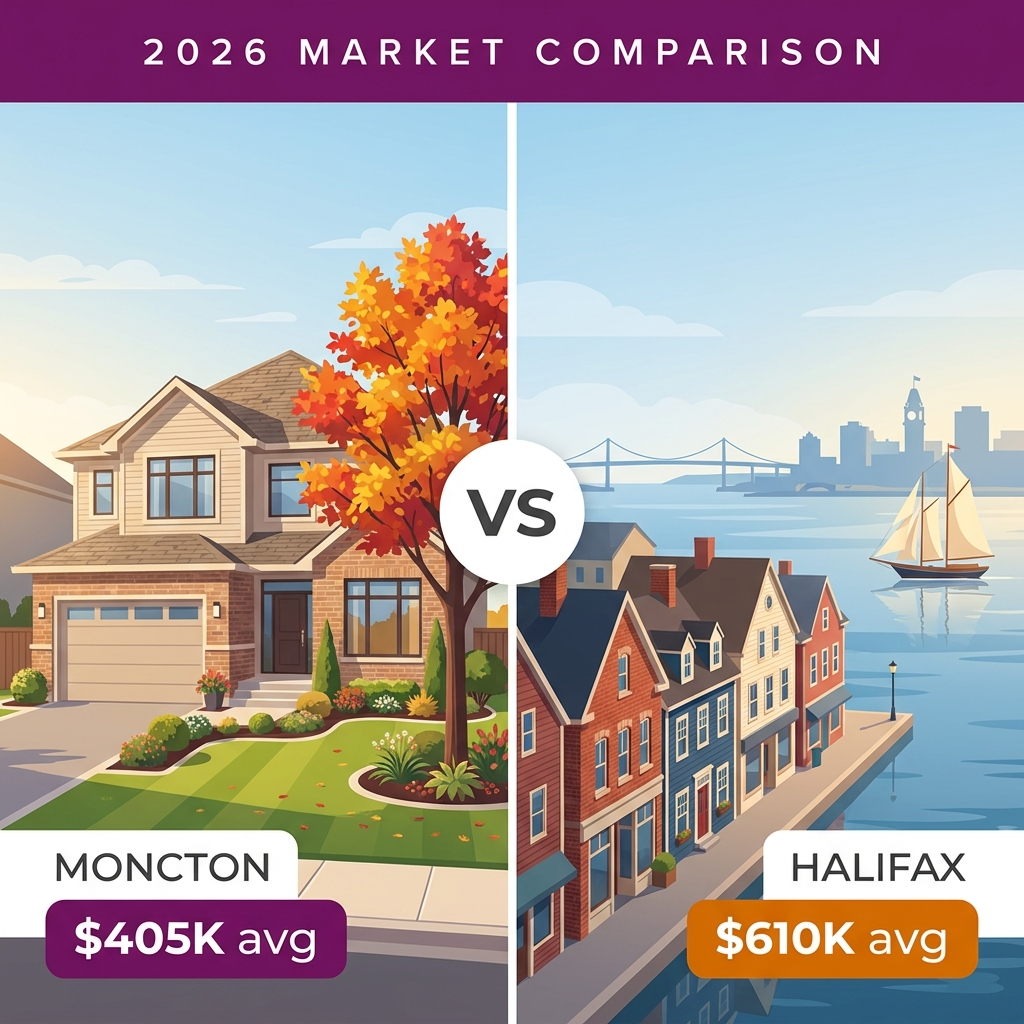
- Moncton vs Halifax on price: Moncton’s average home price is roughly $405,000 in 2026, versus about $610,000 in Halifax.
- This guide compares Moncton vs Halifax on real estate, cost of living, lifestyle, and taxes and transaction costs.
- Use the FAQ at the end for quick Moncton vs Halifax answers on cost, growth and property taxes.
Official city information: City of Moncton and Halifax Regional Municipality.
Moncton vs Halifax: the quick answer
As of March 2026:
- Moncton average home price: ~$405,583 (up 9.1% year-over-year)
- Halifax average home price: ~$610,101 (up 1.3% year-over-year)
- Overall cost of living: Halifax is 23–28% more expensive than Moncton
- Rent for a comparable apartment: Halifax is roughly 53% higher than Moncton
For most buyers, the same budget buys you a significantly larger, newer home in Moncton than in Halifax, with lower carrying costs and no non-resident deed transfer tax.
Moncton vs Halifax real estate market comparison (2026)
| Metric | Moncton (March 2026) | Halifax (March 2026) |
|---|---|---|
| Average sale price | ~$405,583 | ~$610,101 |
| Year-over-year change | +9.1% | +1.3% |
| Median sale price | ~$380,000 | ~$569,450 |
| Typical days on market (spring) | 14–30 days | ~13 days |
| Months of inventory | ~3–4 months (balanced) | ~2.4 months (seller’s) |
| Non-resident deed transfer tax | None | 10% (NS) |
| Land transfer tax | 1% of purchase price | Varies by municipality (~1.5% in HRM) |
Sources: CREA, Nova Scotia Association of REALTORS®, WOWA Halifax Housing Market Report (April 2026), Greater Moncton Real Estate Board.
What $500,000 buys in each city
This is where the difference becomes tangible. At a $500,000 budget in spring 2026:
- In Moncton: A newer 3-bedroom, 2.5-bathroom detached home in a sought-after neighbourhood like Royal Oaks, North End Moncton, or Central Dieppe — often on a larger lot with a double garage, typically built within the last 10–15 years.
- In Halifax: A smaller 3-bedroom semi-detached or townhouse in a suburb like Sackville or Cole Harbour, or an older detached home further from the peninsula. Peninsula and Bedford properties at this price point are increasingly rare.
The $200,000 price gap translates into roughly 500–800 square feet of additional living space, or proximity to amenities, or both.
Cost of living comparison
Housing is the biggest single difference between the two cities, but it’s not the only one. According to data from Expatistan (March 2026) and WOWA’s Canadian cost-of-living comparison:
| Category | Moncton | Halifax | Difference |
|---|---|---|---|
| Average 1-bedroom rent | ~$1,135/month (all-in) | ~$1,445/month (all-in) | +27% |
| Electricity (1,000 kWh) | ~$166 | ~$196 | +18% |
| Monthly food (per person) | ~$443 | ~$436 | Roughly equal |
| Internet + phone (one person) | ~$135 | ~$137 | Roughly equal |
| Auto insurance (annual) | Lower (NB average) | Higher (NS average) | NB typically cheaper |
| Overall index (including rent) | Baseline | +23–36% | Halifax more expensive |
Numbeo’s comparison puts it simply: a household that needs $6,672 per month to live comfortably in Moncton would need approximately $8,000 per month for the same lifestyle in Halifax.
Lifestyle and amenities
Price isn’t everything. Here’s what each city offers that the other doesn’t.
Where Halifax wins
- Oceanfront city: Halifax is a true port city with a historic waterfront, working harbour, and direct access to the Atlantic. Moncton sits inland along the Petitcodiac River.
- Universities and healthcare: Dalhousie, Saint Mary’s, and the QEII Health Sciences Centre give Halifax a stronger concentration of post-secondary and tertiary healthcare jobs.
- Urban density: Downtown Halifax has more walkable neighbourhoods, more restaurants per capita, and a larger arts scene.
- International airport connectivity: YHZ has more direct international routes than YQM.
Where Moncton wins
- Affordability: Lower home prices, lower rent, lower property taxes, and no non-resident deed transfer tax.
- Bilingual community: Greater Moncton is the only officially bilingual metropolitan area in Canada. Dieppe reports 71% French as a mother tongue. Halifax is overwhelmingly English.
- Commute times: The average commute in Greater Moncton is 15–20 minutes. Halifax peninsula commutes routinely run 30–45 minutes from suburbs like Bedford, Dartmouth, or Sackville.
- Central Maritime location: From Moncton, Halifax is 2.5 hours by car, Fredericton is 2 hours, Charlottetown is 2 hours, and the U.S. border is 2 hours. That central position matters for businesses and frequent travellers.
- Growth momentum: Greater Moncton added approximately 27,000 residents between 2021 and 2024. Dieppe alone has a 25.6% recent growth rate.
Taxes and transaction costs
Buyers moving from Ontario or Western Canada often overlook the cross-provincial differences in closing costs. Here’s what matters:
If you’re buying in Moncton
- New Brunswick Land Transfer Tax: 1% of the greater of purchase price or assessed value.
- Legal fees: $1,500–$2,000 typical.
- No non-resident surtax.
- Property tax rate (Moncton, 2026): Approximately $1.4443 per $100 of assessed value for owner-occupied residential.
If you’re buying in Halifax
- Halifax Deed Transfer Tax: 1.5% of purchase price (set by HRM).
- Non-Resident Deed Transfer Tax: 10% of the purchase price if you are not a Nova Scotia resident and don’t move in within six months of closing. This was introduced in 2022 and remains in effect.
- Legal fees: $1,500–$2,500 typical.
- Property tax rate (HRM urban residential, 2026): Approximately $0.833 per $100 of assessed value — but applied to significantly higher assessments.
For a buyer relocating from Ontario, the NS non-resident tax alone can add $40,000–$60,000 to a $500,000 purchase if they can’t establish residency within six months.
Moncton vs Halifax: which city makes sense for you?
After helping dozens of clients relocate to Greater Moncton — many from Ontario, some from Nova Scotia itself — here’s how I’d frame the decision:
Moncton is typically the better fit if:
- You’re price-sensitive and want the most house for your budget.
- You work remotely or have flexibility on location.
- You value short commutes and easy errands.
- You or your family benefits from a bilingual environment.
- You’re relocating from outside Nova Scotia and want to avoid the non-resident deed transfer tax.
Halifax is typically the better fit if:
- Your job is tied to Halifax’s healthcare, military, universities, or port industries.
- You specifically want oceanfront city living.
- Your family includes students attending Dalhousie, SMU, or MSVU.
- You’re willing to pay a premium for more urban density and international connectivity.
Weighing other Maritime cities too? See how Moncton compares to Saint John and Charlottetown.
Moncton vs Halifax: frequently asked questions
Is Moncton cheaper than Halifax?
Yes. The overall cost of living in Moncton is roughly 23–28% lower than in Halifax, driven primarily by housing. Average home prices in Moncton sit near $405,000 in early 2026 compared to approximately $610,000 in Halifax — a difference of more than $200,000 for a comparable single-detached home. Rent, property taxes, and auto insurance are also lower in Moncton.
What is the average home price in Moncton vs. Halifax in 2026?
As of March 2026, the average home price in Moncton is approximately $405,583, up 9.1% year-over-year. In Halifax, the average home price is approximately $610,101 according to WOWA’s March 2026 data, up 1.3% year-over-year. Halifax homes cost roughly 50% more on average than comparable Moncton homes.
Should I move to Moncton or Halifax?
The right choice depends on your priorities. Choose Moncton if affordability, a shorter commute, lower property taxes, and access to both English and French communities matter most. Choose Halifax if you prioritize oceanfront amenities, a larger job market in healthcare and tech, university proximity, and more urban density. Both cities offer strong lifestyle advantages at a fraction of Toronto or Vancouver prices.
Is Halifax or Moncton growing faster?
Both cities are growing, but Greater Moncton is growing faster on a percentage basis. Greater Moncton added approximately 27,000 residents between 2021 and 2024 — one of the fastest growth rates in Atlantic Canada. Halifax has added more residents in absolute numbers due to its larger starting population, but Moncton’s growth rate has outpaced Halifax in recent years, particularly in Dieppe, which has a 25.6% recent growth rate.
Are property taxes lower in Moncton than Halifax?
Yes. Moncton’s municipal tax rate is approximately $1.4443 per $100 of assessed value for residential owner-occupied properties in 2026. Halifax Regional Municipality’s residential urban rate is roughly $0.833 per $100, but Halifax assessments are much higher, so the actual dollar amount paid by a Halifax homeowner on a comparable home is generally higher than in Moncton. Nova Scotia also charges a non-resident deed transfer tax of 10%, which does not exist in New Brunswick.
Thinking about a move to Moncton?
If you’re weighing a move from Halifax — or considering both cities for a cross-country relocation — I’m happy to walk you through current listings, neighbourhood fit, and what your Halifax budget actually buys in Greater Moncton.
No obligation, no pressure. Just honest local insight from someone who has been helping buyers navigate this market for 16 years.