New Brunswick Real Estate · Property Tax Reform
New Brunswick’s 2026 Property Tax Reform: What It Means for Homeowners
After years of property tax bills climbing right alongside soaring assessments, New Brunswick has tabled its most significant property tax reform in a generation. Here’s a plain-language guide to the rebate thresholds, the assessment cap, the new rate stabilizers, and what it all means for homeowners across Greater Moncton and beyond.
If you’ve watched your assessment notice jump and your tax bill follow, you’re not alone — it’s the single most common frustration I hear from homeowners. The province’s response, the Act Respecting Property Tax, was tabled for first reading on May 27, 2026, and sets its foundation beginning with the 2027 taxation year. (2026 itself saw a one-year freeze on assessment values.) Below is what’s actually in it, and how it’s expected to land for the people who own homes here.
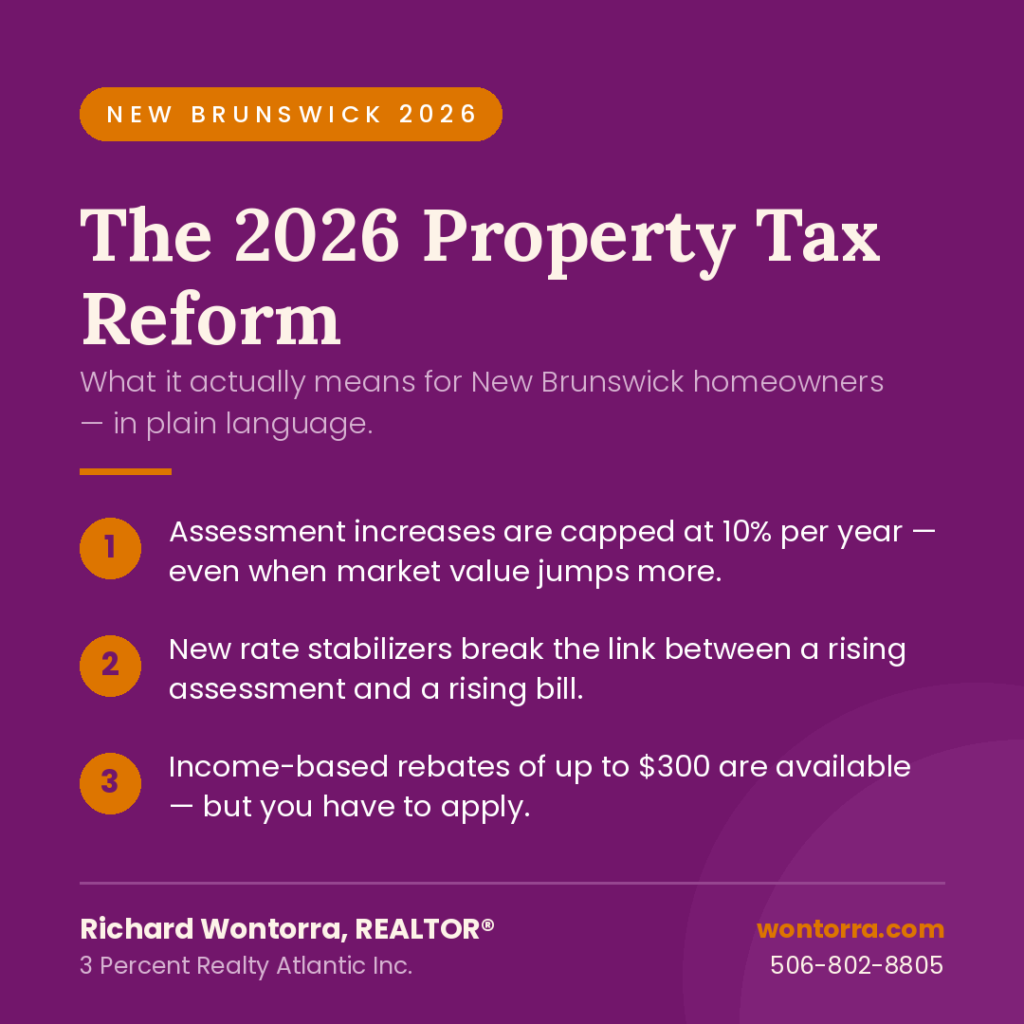
Key takeaways: New Brunswick property tax reform
- New Brunswick’s property tax reform rests on three pillars: an income-based Property Tax Allowance, an assessment cap (spike protection), and new rate stabilizers.
- The Act Respecting Property Tax was tabled on May 27, 2026, with its foundation starting in the 2027 taxation year.
- 2026 itself saw a one-year freeze on assessment values.
Official sources: Government of New Brunswick and Service New Brunswick (property assessment).
1. Income-based rebates: the Property Tax Allowance
The one part of the system that’s tied to income is the Property Tax Allowance — a rebate aimed at lower-income homeowners on their primary residence. It is not automatic; you have to apply, and you reapply each year because income can change. The amount is based on your household’s combined taxable income:
| Household taxable income | Rebate |
|---|---|
| Less than $22,000 | Up to $300 |
| $22,001 – $25,000 | Up to $200 |
| $25,001 – $30,000 | Up to $100 |
Two details worth knowing. First, you must already be receiving the Residential Property Tax Credit (most owner-occupants are) to qualify. Second, if you missed it in past years, you can apply for the current year and up to the three prior years if you were eligible. As part of the reform, the province has signalled it intends to enhance this allowance, so the current-year figure may be higher than the table above — confirm the exact amount with Service New Brunswick before relying on it.
Seniors: a separate option to defer
If at least one owner is 65 or older, the Property Tax Deferral Program for Seniors lets you defer the annual increase in property taxes on your home. The deferred amount accrues interest and is repaid as a lien when the home is eventually sold or transferred — a way to ease cash flow now without losing the home. This is separate from the income-tested allowance and worth a look for fixed-income owners.
2. The assessment cap: property tax spike protection
Your tax bill is really two numbers multiplied together: assessed value × tax rate. Spike protection works on the assessment side. It limits how much of an assessment increase can flow into your taxable value in a single year to a maximum of 10% — even if the market pushed your home’s value up more than that. First introduced in 2013 for owner-occupied homes, it was expanded in 2025 to apply to all property types (with exceptions for new construction and recently sold properties).
The detail buyers need to hear
Spike protection resets when a property changes hands. A new owner is assessed at full current value — they don’t inherit the seller’s capped, phased-in number. That’s why a buyer’s first tax bill can be noticeably higher than what the previous owner was paying. If you’re comparing homes, ask what the bill will look like for you, not just what it says on the current listing.
3. The rate stabilizers: a tale of two programs
This is the genuinely new piece. If spike protection caps the assessment side, the rate stabilizers work on the rate side — and there are two of them, doing different jobs.
Protects the taxpayer
The province publishes a suggested rate for each municipality, built from a Local Government Cost Index (LGCI) — 25% population growth, 25% the Consumer Price Index, 25% non-residential building costs, and 25% New Brunswick wages. The suggested increase is bounded between 0% and 5%. When local assessments rise, the rate is automatically nudged down to offset, so a higher assessment no longer automatically means a bigger bill.
Protects provincial revenue
The provincial version adjusts rates so the province receives a prescribed level of revenue growth regardless of assessment swings. Importantly, the Residential Property Tax Credit zeroes the provincial rate on an owner-occupied home and the first half-hectare of land around it — so a family on a normal lot pays $0 provincial and feels nothing if that rate rises. The provincial rate still applies to land beyond the first half-hectare (think rural or large-acreage properties) and to all non-owner-occupied property: rentals, cottages, vacant land, and commercial buildings.
The accountability difference
Here’s the nuance most coverage skips. A municipal council can still set a rate above the province’s suggested number — but if it does, it must publicly explain why, right on the property tax bills sent to residents. The increase can no longer hide behind rising assessments; it becomes a visible, attributable decision. The provincial side carries no equivalent external check — the province sets its own revenue-growth target and administers its own stabilizer. So the transparency pressure falls mainly on local councils, while the provincial portion is most relevant to investors, landlords, and cottage owners.
A worked property tax reform example
Say a home is assessed at $250,000 and the local rate is held flat from one year to the next — a “zero percent increase,” as several New Brunswick municipalities have announced. Now the market pushes the assessment up 9%, to $272,500.
Under the current model — the “0%” that isn’t
Last year: $250,000 × rate ÷ 100 = your base bill
This year: $272,500 × the same flat rate ÷ 100 = about 9% more
Even with a flat rate, the bill rises roughly 9% — purely because the assessment did. The municipality quietly collects more revenue without ever voting to raise the rate.
Under the new model — rate stabilizer in place
If the municipality’s real cost pressures (via the LGCI) only justified, say, a 2.5% revenue increase, the stabilizer trims the rate to absorb the gap between that and the 9% assessment jump. The result: a bill that rises about 2.5% — matching what it actually costs to run the community, not the assessment spike.
How property tax reform is expected to impact homeowners
More predictable bills. The core promise is that your bill should track the cost of running your community, not the ups and downs of the housing market. For owner-occupants, a hot market year should no longer translate automatically into a painful tax year.
Clearer accountability. Going forward, your bill is meant to tell you who raised your taxes and why — the assessment, the province, or a deliberate choice by your local council. That transparency is, arguably, the most durable change here.
Buyers should still do the math. Because spike protection resets on sale, a new owner’s bill can jump above the previous owner’s. Build the realistic figure into your budget before you buy.
Investors and cottage owners, take note. The provincial portion — the one with the lighter accountability framework and a built-in revenue-growth guarantee — is exactly the portion that lands on non-owner-occupied property. If you’re running cash-flow projections on a rental or a second property, factor that in.
Relief still requires action. The rebate and the seniors’ deferral are not automatic. If you or someone you care about might qualify, applying (and claiming back prior years where eligible) is the step that turns the policy into actual dollars.
Property tax reform: frequently asked questions
When do the New Brunswick property tax changes take effect?
The Act Respecting Property Tax was tabled for first reading on May 27, 2026, and sets its foundation starting with the 2027 taxation year. 2026 had a one-year freeze on assessment values, and the redesigned bills showing the suggested versus actual local rate are expected to begin the following year.
How much is the NB Property Tax Allowance and who qualifies?
It is an income-tested rebate on your primary residence: up to $300 if household taxable income is under $22,000, up to $200 between $22,001 and $25,000, and up to $100 between $25,001 and $30,000. You must already receive the Residential Property Tax Credit, you apply each year, and you can claim back up to three prior years if you were eligible. The province has indicated it intends to enhance the allowance, so confirm the current amount with Service New Brunswick.
What is the assessment spike cap in New Brunswick?
Spike protection limits how much of an assessment increase flows into your taxable value to a maximum of 10% per year, even when market value rises more. It applies to all property types as of 2025, with exceptions for new construction and recently sold properties. Note that the protection resets when a property is sold, so a new owner is assessed at full current value.
What is the difference between the local and provincial rate stabilizer?
The local rate stabilizer protects taxpayers: it ties the suggested municipal rate to a cost index and automatically lowers rates when local assessments rise, and councils must publicly justify any rate set above the suggested number. The provincial rate stabilizer instead adjusts rates so the province receives a prescribed level of revenue growth. The Residential Property Tax Credit zeroes the provincial rate on an owner-occupied home and the first half-hectare of land around it, so a family on a normal lot pays none of it. The provincial rate still applies to land beyond that first half-hectare and to non-owner-occupied property such as rentals, cottages, vacant land, and commercial buildings.
Will my property tax bill actually go down?
Not necessarily. The reform is designed so your bill tracks the cost of running your municipality rather than rising automatically with your assessment. Whether a given bill rises, holds, or falls depends on your municipality’s budget and the rate its council ultimately sets.
Can seniors defer property tax in New Brunswick?
Yes. If at least one owner is 65 or older, the Property Tax Deferral Program for Seniors allows you to defer the annual increase on your principal residence. The deferred amount accrues interest and is repaid as a lien when the property is sold or transferred.
Thinking about buying or selling in Greater Moncton?
Understanding your real tax picture is part of making a smart move. I’m always glad to walk through the numbers on any home you’re considering — no pressure, just clarity.
Get in touch →Richard Wontorra is a REALTOR® with 3 Percent Realty Atlantic Inc., serving Greater Moncton and Saint John. This article is general information, not tax or legal advice. For exact figures and eligibility in your situation, contact Service New Brunswick or a qualified professional. Phone: 506-802-8805 · wontorra.com