I test my own home for radon, and I recommend radon testing in Moncton to every buyer and seller I work with. That’s not something most REALTORS® say — but once you understand what radon actually is and how common it is in Greater Moncton, it becomes a straightforward decision.
New Brunswick has one of the highest residential radon rates in Canada, and the Moncton area is not exempt. If you’re buying or selling a home here, radon is something you need to understand — not to be alarmed about, but because knowledge protects you and the people you’re transacting with.
Here’s everything you need to know going into a 2026 real estate transaction in New Brunswick.
Key takeaways: radon testing in Moncton
- Radon testing in Moncton is not legally required in a real estate deal, but it should be standard practice.
- Health Canada recommends a long-term test of at least three months for the most reliable result.
- High radon rarely kills a deal, because mitigation systems are common and effective.
Guidelines and testing advice: Health Canada, Radon.
What is radon, and why does NB have so much of it?
Radon is a naturally occurring radioactive gas that forms when uranium in soil and rock breaks down. It’s colourless, odourless, and tasteless — completely undetectable without a test. Outdoors, it disperses harmlessly into the air. The problem is when it seeps into an enclosed space like a home, where it can accumulate to levels that pose a real health risk.
Long-term exposure to elevated radon is the second leading cause of lung cancer in Canada, after smoking — and the leading cause of lung cancer in people who have never smoked. Radon accounts for roughly 3,200 lung cancer deaths in Canada annually. For smokers, the risk compounds significantly, exposure to radon and tobacco smoke together can raise lung cancer risk by up to 20 times compared to radon exposure on its own.
New Brunswick’s geology — particularly the uranium-bearing granite and sedimentary rock underlying much of the province — makes it one of the higher-risk regions in the country. The 2024 Cross-Canada Radon Survey found that 1 in 4 NB homes have radon levels at or above Health Canada’s guideline of 200 Bq/m³. Some regions in the province see rates as high as 40% of tested homes exceeding the guideline. That puts NB alongside Manitoba, Saskatchewan, and the Yukon among the highest-risk provinces.
Critically: levels vary dramatically even between neighbouring homes on the same street. The only way to know what’s happening in a specific property is to test it.
How does radon get into a home?
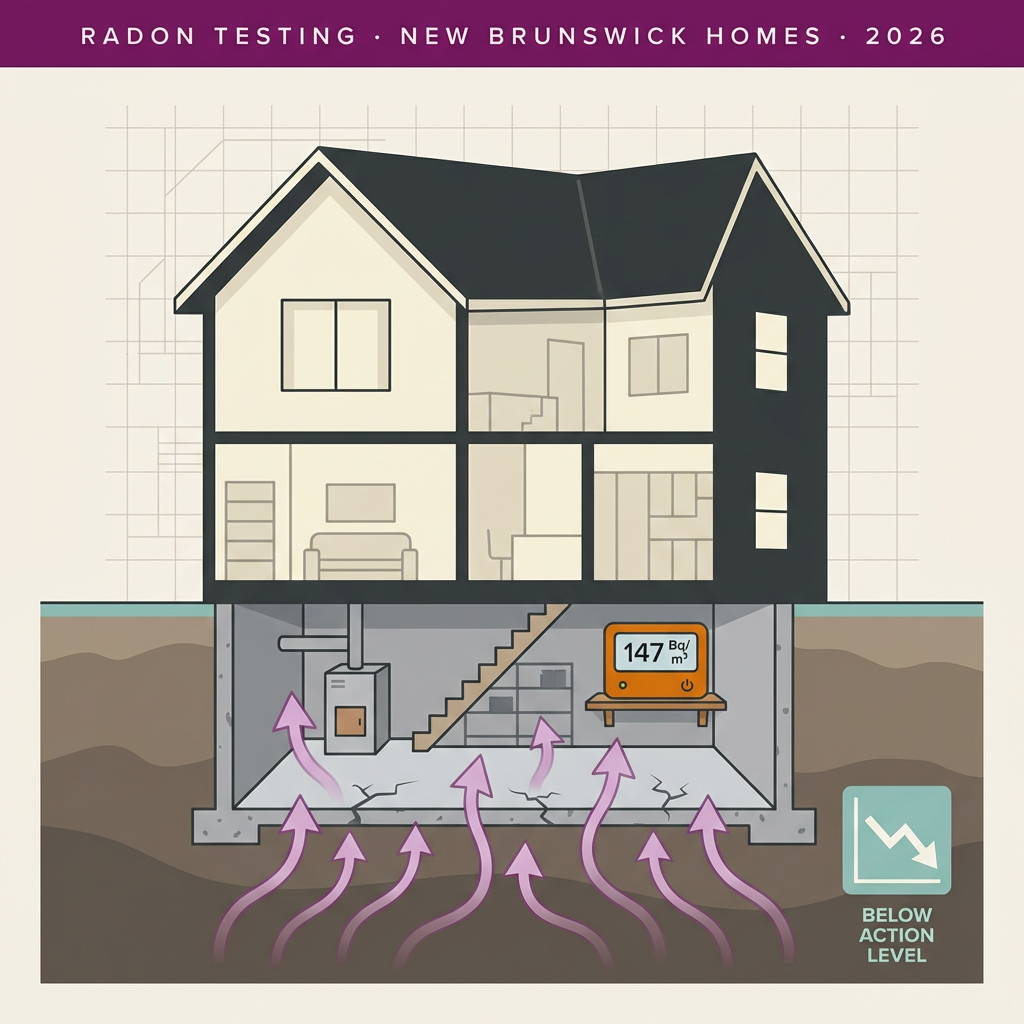
Radon travels upward through soil and enters homes through any point of contact between the building and the ground: cracks in foundation walls or floor slabs, gaps around pipes and utility penetrations, sump pits, exposed soil or gravel in crawl spaces, and floor drains. New Brunswick’s cold climate compounds the problem — well-sealed, energy-efficient homes retain heat in winter but also trap radon that enters from below.
Radon concentrations are almost always highest in the basement or lowest occupied level of a home, and lower on upper floors. A finished basement where family members spend significant time — a rec room, a home office, a bedroom — is where prolonged exposure matters most.
Homes built in New Brunswick after 2015 may have radon mitigation rough-ins already installed, which makes retrofitting a system easier and cheaper if elevated levels are found.
What buyers need to know about radon in Moncton
Radon testing is not legally required — but it should be standard practice
There is no legal requirement in New Brunswick for sellers to test for radon or disclose test results prior to a sale. However, given the province’s radon profile, the New Brunswick Real Estate Association (NBREA) strongly recommends that buyers treat radon as a standard part of their due diligence — equivalent in importance to a home inspection.
Here are your practical options as a buyer:
- Ask if the home has been tested. If results exist and are above 200 Bq/m³, you need to know — and factor remediation costs into your offer.
- Include a radon condition in your offer. This gives you the right to test the property, typically over 48–96 hours with a short-term device, before waiving conditions. A short-term test gives a useful early indicator, though Health Canada recommends long-term testing (90+ days) for the most accurate reading.
- Negotiate on the result. If a test comes back elevated, you have options: request a price reduction to offset mitigation costs, ask the seller to install a mitigation system before closing, or include a trust holdback pending post-closing remediation.
- Test after you move in. If you purchase without a radon condition, Health Canada recommends testing your new home in the first heating season (October through April).
What the numbers mean
| Radon Level (Bq/m³) | Health Canada Guidance |
|---|---|
| Below 100 | Low risk. No action required. |
| 100–200 | Moderate. Consider mitigation, especially if you spend significant time in lower levels. |
| 200–600 | Above guideline. Health Canada recommends remediation within 2 years. |
| Above 600 | Significantly elevated. Health Canada recommends remediation within 1 year. |
The World Health Organization uses a lower reference level of 100 Bq/m³. Health Canada’s guideline is 200 Bq/m³.
What sellers need to know
Test before you list — don’t wait to be surprised
If you haven’t tested your home for radon, do it before you put the home on the market. Here’s why: a buyer’s radon test that comes back elevated mid-transaction puts you in a reactive position. You’re negotiating on their timeline, under pressure, with less information than they have.
Testing before listing gives you control. If levels are fine, you can say so confidently — and that’s actually a selling point in a market where buyers are increasingly radon-aware. If levels are elevated, you can decide whether to install a mitigation system before listing (adding it as a feature) or price accordingly and disclose upfront.
Disclosure is the right call
While NB law doesn’t mandate radon disclosure, real estate best practice — and basic ethics — is to disclose known material defects. If you’ve tested and the result was above guideline, that’s information a buyer would consider material. Non-disclosure of a known elevated radon reading could expose you to legal liability after closing. Work with your REALTOR® and lawyer on the appropriate disclosure approach.
High radon doesn’t kill a deal
This is the most important thing for sellers to understand. A mitigation system that costs $3,000–$5,000 and can be installed in less than a day is not a deal-breaker. Buyers who understand radon — and more of them do every year — know that a home with a properly installed mitigation system and a post-remediation test result below 100 Bq/m³ is arguably in better shape than an untested home. Frame it as due diligence done, not a problem hidden.
How radon is handled in a New Brunswick APS (Offer to Purchase)
When radon comes up in a transaction, the NBREA outlines several common approaches:
- Buyer tests after closing: The offer proceeds without a radon condition. The buyer tests in the first heating season. If elevated, the cost of mitigation is theirs — this is the highest-risk option for buyers.
- Radon condition in the offer: The buyer has the right to complete testing before removing conditions. If results exceed 200 Bq/m³, the buyer can negotiate or walk away.
- Trust holdback: A sum (typically covering estimated mitigation costs) is held in trust by the lawyers. If post-closing testing comes back below guideline, funds return to the seller. If elevated, funds cover mitigation. This keeps the transaction moving while protecting both parties.
- Price adjustment: The parties agree on a purchase price reduction reflecting the estimated remediation cost, and the buyer handles mitigation after closing.
Radon testing in Moncton: what to buy, where to get it, how it works
Health Canada recommends testing over a minimum of 90 days, ideally during the heating season (September to April) when ventilation is lowest and radon concentrations are typically at their highest. The test device is placed in the lowest occupied level of the home, in a room where people spend time — a basement bedroom, living room, or home office.
Where to get a test kit in New Brunswick:
- NB Lung (nblung.ca) — long-term test kits available for order
- New Brunswick public libraries — Gold Standard radon test kits are now available at all 63 NB libraries
- Local hardware stores — short-term and long-term kits available at many retailers
- C-NRPP certified professionals (c-nrpp.ca) — for professional testing with a certified result
DIY long-term kits typically run $30–$50. You mail the completed detector to a lab and receive results within a few weeks. Professional testing costs more but may be preferred for real estate transactions where a certified result carries more weight in negotiations.
Mitigation: what it costs and how it works
If your home tests above 200 Bq/m³, the solution is reliable and well-established. The most effective method is active soil depressurization (ASD): a certified professional installs a pipe through the foundation floor slab (or from a sump pit) and connects it to a small fan that runs continuously. The fan creates negative pressure beneath the foundation, drawing radon from the soil and venting it above the roofline — where it disperses harmlessly outdoors.
The system is quiet, runs on about as much electricity as a light bulb, and can reduce indoor radon levels by more than 80% in most homes. Installation typically takes less than a day.
Cost in New Brunswick: $3,000–$5,000 for most homes, depending on size, design, and complexity. After installation, re-test to confirm the system is working as expected — and re-test again after any major renovation that affects the home’s structure or ventilation.
For a borderline reading just above guideline, sealing visible foundation cracks and improving crawl space ventilation can help reduce radon entry as a lower-cost first step. These measures alone rarely bring a significantly elevated result down far enough on their own, but they’re worth doing regardless and can reduce the load on a mitigation system.
Hire only a C-NRPP certified radon mitigation professional. Find certified contractors at c-nrpp.ca or by calling 1-855-722-6777.
What about well water? Iron and manganese in New Brunswick homes
If your home, or the one you’re buying, is on a private well, radon isn’t the only thing worth testing for. Iron and manganese are common in New Brunswick groundwater. They’re more of a nuisance than a serious health issue at typical levels, but it’s worth knowing what you’re dealing with.
Health Canada sets an aesthetic guideline of 0.3 mg/L for iron and 0.12 mg/L for manganese. Above those levels, you’ll usually notice it before you test for it: reddish-brown staining on fixtures and laundry, a metallic taste, and over time, sludge buildup that can reduce water flow and add wear on plumbing and appliances. At meaningfully higher concentrations, health guidance points to digestive effects from excess iron and, for manganese, possible neurological effects with long-term exposure, particularly a concern for young children.
A private well should be tested for iron and manganese alongside the standard bacteria and nitrate testing most buyers already do. If levels come back elevated, treatment (typically an iron and manganese filtration system) is a straightforward, well-established fix, similar in spirit to radon mitigation: a known problem with a known solution, not a reason to walk away from an otherwise good property.
The bottom line on radon testing in Moncton
Radon is the one home health issue I consistently bring up with clients — buyers and sellers alike — regardless of where the property is in Greater Moncton. NB’s rates are too high and the health stakes too real to leave it off the table.
The good news: this is a solvable problem. A test kit costs less than a dinner out. A mitigation system costs less than a new furnace. And the peace of mind that comes from knowing your home’s radon level — whether you’re moving in or moving on — is worth every dollar.
If you have questions about how radon fits into your specific buying or selling situation in Moncton, Dieppe, or Riverview, I’m happy to walk through it with you.
Buying or selling in Greater Moncton?
I test my own home for radon and I’ll make sure radon is part of your transaction — not an afterthought. Let’s talk.
Richard Wontorra, REALTOR®
3 Percent Realty Atlantic Inc.
506-802-8805 · Richard@Wontorra.com
1888 Mountain Road, Suite 2, Moncton, NB E1G 1A9
This post is for informational purposes only. For health guidance on radon, consult Health Canada or your physician. For certified radon testing and mitigation in New Brunswick, use a C-NRPP certified professional.
If you have questions about radon testing in Moncton before you buy or list, I’m happy to walk you through the options. Booking radon testing in Moncton early keeps it from becoming a last-minute surprise in your deal.
FAQ: radon testing in Moncton
How common is radon in Moncton and New Brunswick homes?
Very common. The 2024 Cross-Canada Radon Survey found that 1 in 4 NB homes exceed Health Canada’s guideline of 200 Bq/m³ — one of the highest rates in Canada. Some NB regions see rates as high as 40%. Levels vary home by home, so every property needs its own test.
Is radon testing required when buying a home in New Brunswick?
Not legally required, but strongly recommended. Buyers can include a radon test condition in their offer, request existing test results from the seller, or test after moving in during the first heating season. Given NB’s radon profile, treating it like a standard part of due diligence makes sense.
How much does a radon test cost in New Brunswick?
DIY long-term test kits are $30–$50, available from NB Lung, all 63 NB public libraries, and some hardware stores. Professional C-NRPP certified testing costs more but provides a certified result suited for real estate negotiations.
How much does radon mitigation cost in New Brunswick?
Typically $3,000–$5,000 for most homes. Active soil depressurization (ASD) is the most common method — a pipe and fan system installed in less than a day that vents radon above the roofline. Most systems reduce radon by more than 80%.
Does high radon affect the value of a home in NB?
Not significantly, because it’s fixable. A mitigation system is comparable in cost to replacing a furnace. In a transaction, elevated radon is typically handled through price negotiation, a condition, or a trust holdback — rarely a deal-breaker for an informed buyer working with a knowledgeable REALTOR®.
Related reading: