Moncton School Zones & Real Estate: How to Buy in the Right Catchment (2026)
If you’re buying a home in Greater Moncton with school-aged kids, Moncton school zones (the catchment areas) matter as much as the floor plan. I’ve had clients fall in love with a house, write the offer, and only realize after closing that their daughter would be bused 25 minutes past the school they assumed she’d attend. It’s an avoidable mistake — but only if you check before you sign, not after.
Here’s how Moncton’s two parallel school systems work, how to verify a property’s catchment in five minutes, and what’s coming down the pipe that could shift things over the next three to five years.
Key takeaways: Moncton school zones
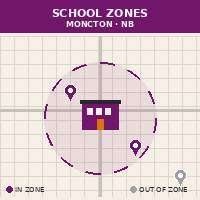
- Moncton school zones are set by two parallel districts, and the anglophone and francophone systems each have their own catchments.
- Always verify a property’s catchment with the district’s BusPlanner tool before you write an offer.
- Some Moncton school zones are in flux, including a new K–8 school and north-end overcrowding pressure.
Verify an address: Anglophone East School District BusPlanner.
This is exactly the kind of neighbourhood-level detail a Moncton realtor should walk you through before you fall in love with a house.
Greater Moncton has two parallel school districts — both with their own catchments
Unlike most Canadian cities, Moncton families have a real choice between two complete public school systems:
- Anglophone East School District (ASD-E) — operates ~38 schools across Westmorland and Albert counties, with roughly 19,000 students. Offers English Prime and French Immersion. Headquartered in Moncton.
- District scolaire francophone Sud (DSFS) — operates ~38 schools across central and southern New Brunswick, with about 18,000 students. French is the language of instruction. Headquartered in Dieppe.
Both districts assign students to a specific school based on civic address. If you live within a school’s boundary and there’s space and a program available, that’s your catchment school. The catch is that boundaries don’t follow neighbourhood names — they follow streets, sometimes mid-block. Two homes on the same street can fall into different zones.
The single most important tool: BusPlanner Web
For Anglophone East, there’s an official lookup tool every Moncton buyer should bookmark: BusPlanner Web at asdebp.nbed.nb.ca/Eligibility. Type in the civic address and it returns the assigned elementary, middle, and high school for that property — same data the district uses internally.
For Francophone Sud, there’s no equivalent public tool. Call the district directly at 506-856-3333 with the address before making an offer if French-first instruction is essential. They’ll confirm the assigned school in a few minutes.
What this means for your offer: Run the BusPlanner check before you write — not after. If the result surprises you, you can adjust your offer, walk away, or proceed with eyes open. Don’t rely on a listing description, a real estate website’s “school” field, or what the seller’s neighbour told them five years ago. School boundaries shift; only the district’s data is current.
French Immersion: how it actually works in Moncton
This is one of the most-asked questions I get from out-of-province families relocating here, and the answers online are often confused or out of date. Here’s the current 2026 picture:
Within the Anglophone East system, students start in English Prime by default. French Immersion has two entry points:
- Early French Immersion — begins in Grade 1. Up to 90% of instruction is in French in the early years.
- Late French Immersion — begins in Grade 6. Intensive French instruction with a faster ramp.
Parents register the choice on a form provided by the school in Kindergarten or Grade 5. Parents do not need to speak French — the program is designed for non-Francophone families. About 99% of New Brunswick French Immersion students reach B1 (intermediate) oral proficiency or higher by program end, which is conversational level and competitive nationally.
Within the District scolaire francophone Sud, French is the primary language of instruction across all subjects. Admission is governed by Section 23 of the Charter — meaning at least one parent typically needs to be a Francophone, an English-speaker who received their primary education in French in Canada, or have a child already attending a Francophone school. If you’re not sure whether your family qualifies, the DSFS admissions office will tell you.
What’s changing in Moncton school zones (and could affect your purchase)
Two things every Moncton home buyer with kids should know about right now:
1. The new Moncton K–8 school replacing Forest Glen + Sunny Brae
The 2026-27 NB capital budget includes more than $3 million for a new modern K–8 school in Moncton that will absorb students currently attending Forest Glen Elementary and Sunny Brae Middle School. When that school opens, catchment lines for those neighbourhoods will be redrawn. If you’re buying in the central / older Moncton area where these schools currently serve, ask your REALTOR® whether the property is likely to be inside or outside the new K–8’s catchment.
2. North-end overcrowding pressure
Northrup Frye School and Evergreen Park School in north Moncton have been chronically over capacity, while several other schools in the district have hundreds of empty seats. The District Education Council has explored boundary changes more than once. If you’re buying in the north end and a specific school is the reason, factor in that the line might be redrawn before your child finishes Grade 5.
3. Capital priorities still on the wait-list
A new secondary school in Moncton and a new elementary school in Riverview were both flagged as priorities by the DSFS but did not make the 2026-27 budget. They remain on the request list, but timing is uncertain. If you’re a Francophone family relocating with the expectation of a new school opening soon, get current information directly from the district before factoring it into a buying decision.
Does Moncton have “school-zone premiums” on home prices?
This is the question relocating buyers from Toronto, Ottawa, and Vancouver ask most often, and the honest answer is: not really, not the way you’re used to.
In high-demand Ontario or BC markets, two identical homes a block apart can differ by $100,000+ purely because of school catchment. In Greater Moncton the differences are much narrower. What I do see in the local market:
- Homes inside French Immersion-feeder catchments (especially elementary schools that feed into strong middle and high school immersion streams) tend to move faster among bilingual-minded buyers.
- Walkability to a desirable elementary school can support a small premium in family-focused price ranges, but it’s usually measured in days-on-market rather than dollars.
- Bessborough School (Riverview), Harrison Trimble High School (Moncton), and École Mathieu-Martin (Dieppe) catchments are the ones I’m asked about most often by name. None of them carry a “you must pay 10% more” sticker, but they do help homes sell more quickly.
Bottom line: in Greater Moncton, fit matters more than reputation. The right school for your child is more valuable than the right name on a yard sign.
Five steps for checking Moncton school zones before you buy
- Decide on language pathway first. English Prime, Early French Immersion, Late French Immersion, or Francophone Sud — that decision narrows your map before price does.
- Run BusPlanner on every shortlist property. Or call DSFS at 506-856-3333 if you’re going Francophone. Do this before you write the offer, not after.
- Visit the actual school — not just the website. Most principals will allow a tour for a serious buyer. Ten minutes of walking the building tells you more than any review site.
- Ask about pending boundary changes in the area you’re considering. A good local REALTOR® should know what’s in the capital budget and what the DEC has been discussing.
- Confirm transportation eligibility. Bus service depends on distance from the school and the catchment rules. A home in-catchment without bus eligibility can become an unexpected daily commute.
The cross-boundary application — and why I rarely recommend banking on it
Anglophone East does accept Out-of-Geographic-Boundary (OGB) applications, but the rule is straightforward: in-catchment students get placed first, OGB students get whatever space is left. Some years that works fine. In growth-area schools like Northrup Frye it almost never does. If your strategy is “we’ll buy here and apply OGB for that school over there,” you’re betting your child’s placement on space the district may not have. I always tell clients: if a specific school is non-negotiable, buy in the catchment.
Moving to Greater Moncton? Check school zones first
I’ve helped families across the Anglophone-Francophone spectrum land in the right catchment — couples relocating from Toronto wanting Early French Immersion, Acadian families coming home from Alberta to Mathieu-Martin’s feeder zone, parents tracking Bessborough’s catchment line down to the specific street.
If you’d like a no-pressure conversation about your priorities — language, distance, future moves, French Immersion vs. Francophone — I’d be happy to help you map it out before you start touring homes. That one conversation often saves families months of wasted showings in the wrong neighbourhood. First-time buyer? Start with our guide to the best starter neighbourhoods in Greater Moncton.
Richard Wontorra, REALTOR®
3 Percent Realty Atlantic Inc.
506-802-8805 · Richard@Wontorra.com
1888 Mountain Road, Suite 2, Moncton, NB E1G 1A9
Related reading:
- Best Neighbourhoods in Moncton for Families (2026)
- Moncton vs. Fredericton: Which NB City Is Right for You?
- Relocating to Moncton from Ontario: A Complete Guide
- Closing Costs in New Brunswick (2026)
- First-Time Home Buyer Programs in New Brunswick